
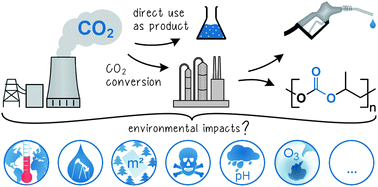
As global concerns about climate change and greenhouse gas emissions rise, carbon dioxide capture and storage (CCS) emerges as a pivotal technology in mitigating environmental impact. CCS serves as a bridge in the transition towards sustainable energy systems. By capturing carbon dioxide (CO2) emissions from industrial activities and storing them underground, this technology helps reduce the amount of CO2 entering the atmosphere, playing a crucial role in addressing climate change. Understanding the intricacies of CCS is essential for realizing its potential benefits and overcoming its challenges.
What is Carbon Dioxide Capture and Storage?
Carbon dioxide capture and storage is a technological process designed to reduce the amount of CO2 released into the atmosphere from industrial sources. It involves three main steps:
- Capture: The process of capturing CO2 from industrial sources such as power plants and factories before it is emitted into the atmosphere.
- Transport: The captured CO2 is then transported to a storage site, typically through pipelines.
- Storage: The CO2 is injected into deep underground rock formations for long-term storage.
Methods of Carbon Dioxide Capture
Pre-combustion Capture
Pre-combustion capture involves removing CO2 before the combustion process. This is typically done in integrated gasification combined cycle (IGCC) power plants where coal or natural gas is converted into a mixture of hydrogen and carbon dioxide. The CO2 is then separated and captured.
Post-combustion Capture
Post-combustion capture occurs after the fuel has been burned. This method is commonly applied to existing power plants. The flue gas from combustion is treated to extract CO2 using solvents or other chemical processes. This approach is especially relevant for retrofitting existing infrastructure.
Oxy-fuel Combustion
Oxy-fuel combustion involves burning fossil fuels in oxygen instead of air, resulting in a flue gas that is mainly water vapor and CO2. The water vapor can be condensed, leaving a concentrated stream of CO2 that can be captured more easily.
Transporting Captured Carbon Dioxide
Once captured, the next step is to transport the CO2 to a suitable storage site. This is typically done via pipelines, which are considered the most efficient method for large-scale transport. However, other methods such as shipping or road transport may be used depending on the distance and volume involved.
Storage Techniques
CO2 storage involves injecting the gas into geological formations, such as depleted oil and gas fields or deep saline aquifers. The suitability of a storage site is determined by its geological characteristics, which must ensure that the CO2 remains trapped over the long term.
- Depleted Oil and Gas Fields: These sites are often used because they have a proven ability to contain gases and liquids.
- Deep Saline Aquifers: These are porous rock formations filled with salty water, offering vast storage potential worldwide.
Challenges and Opportunities
Despite its potential, CCS faces several challenges. These include high costs, energy requirements for the capture process, and the need for extensive infrastructure. However, ongoing research and development aim to make CCS more cost-effective and efficient. Moreover, policies and incentives are crucial in encouraging the adoption of CCS technology.
The development of carbon dioxide capture technology continues to evolve, offering innovative solutions to reduce emissions and mitigate climate change. As industries and governments recognize its importance, the implementation of CCS can become a cornerstone of global efforts to achieve a sustainable future.